

• 321867
| Product name | B-hLRRC15 MC38 |
|---|---|
| Catalog number | 321867 |
| Strain background | C57BL/6 |
| NCBI gene ID | (Human) |
| Aliases | LIB; 5430427N11Rik |
| Tissue | Colon |
| Disease | Colon carcinoma |
| Species | Mouse |
| Application | B-hLRRC15 MC38 |

The mouse Lrrc15 gene was replaced by human LRRC15 coding sequence in B-hLRRC15 MC38 cells. Human LRRC15 is highly expressed on the surface of B-hLRRC15 MC38 cells.

Gene targeting strategy for B-hLRRC15 MC38 cells. The exogenous promoter and human LRRC15 coding sequence was inserted to replace part of murine exon 2. The insertion disrupts the endogenous murine Lrrc15 gene, resulting in a non-functional transcript.

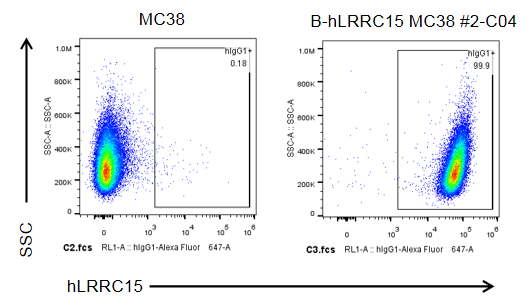
LRRC15 expression analysis in B-hLRRC15 MC38 cells by flow cytometry. Single cell suspensions from wild-type MC38 and B-hLRRC15 MC38 cultures were stained with species-specific anti-LRRC15 antibody. Human LRRC15 was detected on the surface of B-hLRRC15 MC38 cells but not wild-type MC38 cells. The 2-C04 clone of B-hLRRC15 MC38 cells was used for in vivo experiments.

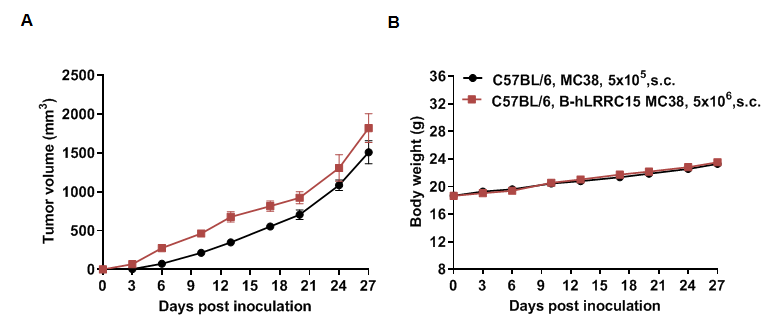
Subcutaneous homograft tumor growth of B-hLRRC15 MC38 cells. B-hLRRC15 MC38 cells (5x10⁶) and wild-type MC38 cells (5x10⁵) were subcutaneously implanted into C57BL/6 mice (female, 7-9-week-old, n=8). Tumor volume and body weight were measured twice a week. (A) Average tumor volume ± SEM. (B) Body weight (Mean± SEM). Volume was expressed in mm3 using the formula: V=0.5 X long diameter X short diameter2. As shown in panel A, B-hLRRC15 MC38 cells were able to establish tumors in vivo and can be used for efficacy studies.
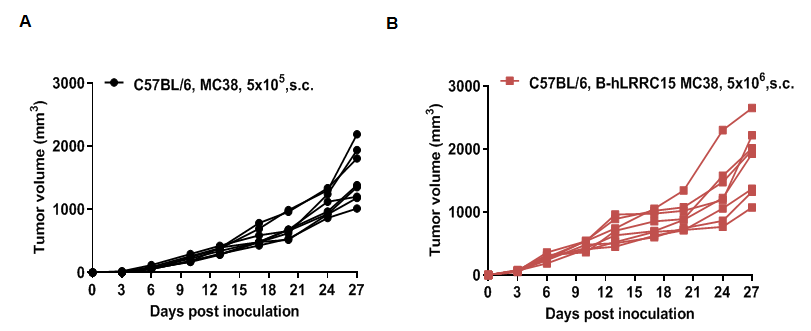
B-hLRRC15 MC38 tumor cells growth of individual mice. B-hLRRC15 MC38 cells (5x10⁶) and wild-type MC38 cells (5x10⁵) were subcutaneously implanted into C57BL/6 mice (female, 7-9-week-old, n=8). As shown in panel, B-hLRRC15 MC38 cells were able to establish tumors in vivo and can be used for efficacy studies.
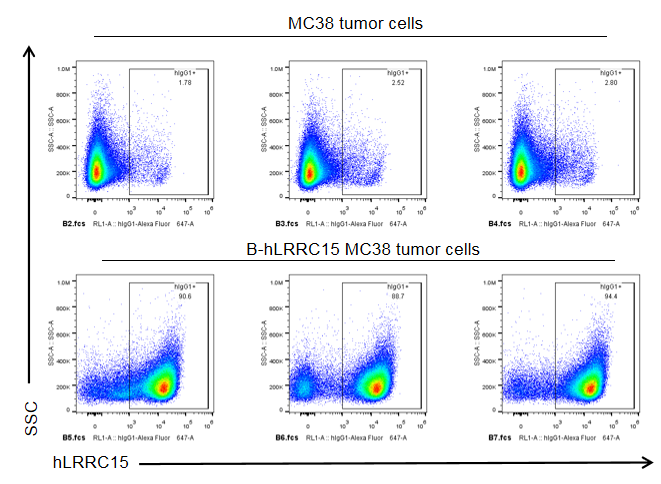
B-hLRRC15 MC38 cells were subcutaneously transplanted into C57BL/6 mice (n=6). At the end of the experiment, tumor cells were harvested and assessed for human LRRC15 expression by flow cytometry. As shown, human LRRC15 was highly expressed on the surface of tumor cells. Therefore, B-hLRRC15 MC38 cells can be used for in vivo efficacy studies of novel LRRC15 therapeutics.
