
Crossing the blood–brain barrier (BBB) remains one of the greatest challenges in CNS drug development. Over 98% of small molecules and nearly all biologics fail to efficiently penetrate the BBB, limiting treatment options for diseases such as Alzheimer’s disease, Parkinson’s disease, and brain tumors. BBB shuttle antibodies targeting transport receptors offer a promising strategy to enable therapeutic delivery into the brain.
Leverage Biocytogen’s RenMice® platforms and large-scale in vivo antibody discovery capabilities to access a grab-and-go portfolio of BBB shuttle antibodies for CNS drug delivery. These ready-to-partner assets include fully human monoclonal antibodies, common light chain antibodies, heavy-chain-only antibodies (HCAbs), and VHHs targeting key BBB transport receptors such as TfR1 and CD98, enabling receptor-mediated transcytosis (RMT) across the BBB.
Grab-and-go access for immediate licensing and pipeline integration
RenMice® platforms enable large-scale in vivo discovery of fully human antibodies with diverse epitope coverage and optimized functional profiles
From antibody discovery to in vivo validation in specialized mouse models
Licensing and co-development options enabling rapid advancement
CD71 (Transferrin Receptor 1, TfR1) mediates cellular uptake of transferrin–iron complexes and is highly expressed on brain endothelial cells. TfR1 is a well-established BBB shuttle target, supporting therapies such as JR-141 for Hunter syndrome and clinical candidates like trontinemab for Alzheimer’s disease.

Fully Human
HCabs
8 HCAbs in a compact format with low immunogenicity.

High Affinity &
Cross-Reactivity
High affinity (2–10 nM) with human/cyno cross-reactivity.

Superior In Vivo
Brain Penetration
Lead clone Ab.38 shows a 1.98% brain-to-serum ratio (JR-141 analog: 0.86%), driven by a distinct non-blocking epitope.

Engineering
Flexibility
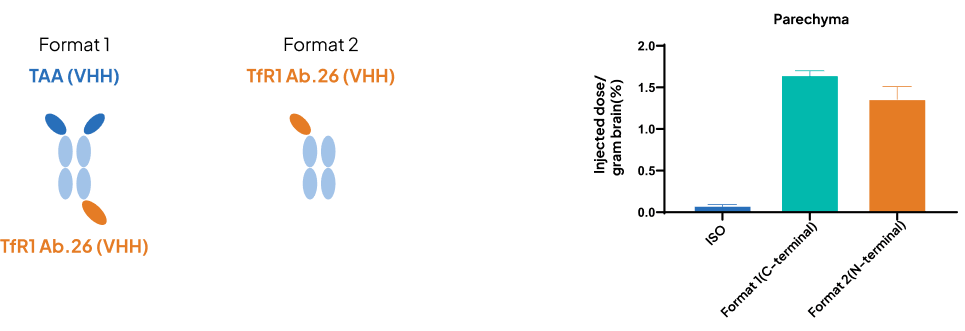
Maintains BBB penetration with N- or C-terminal fusion. Effective in both monovalent and bivalent fusion formats.

Next-Gen Delivery
Vehicles
DAR1-friendly for site-specific conjugation; suitable for bispecifics and AOCs.
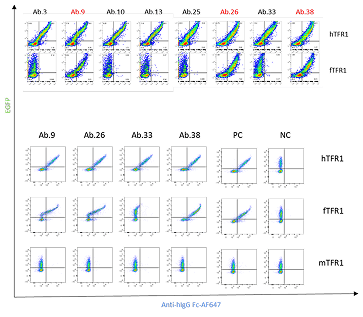
| Antibody | Human TfR1 KD (M) | Cyno TfR1 KD (M) |
| Ab.3 | 1E-08 | negative |
| Ab.9 | 8E-09 | 2E-08 |
| Ab.10 | 1E-08 | negative |
| Ab.13 | 9E-09 | negative |
| Ab.26 | 2E-09 | 2E-09 |
| Ab.38 | 2E-09 | 1E-09 |
| JR-141 | 1.7E-10 | 1E-8 |
hTFR1: Human TFR1; fTFR1: Macaca fascicularis (cynomolgus monkey) TFR1; mTFR1: Mouse TFR1
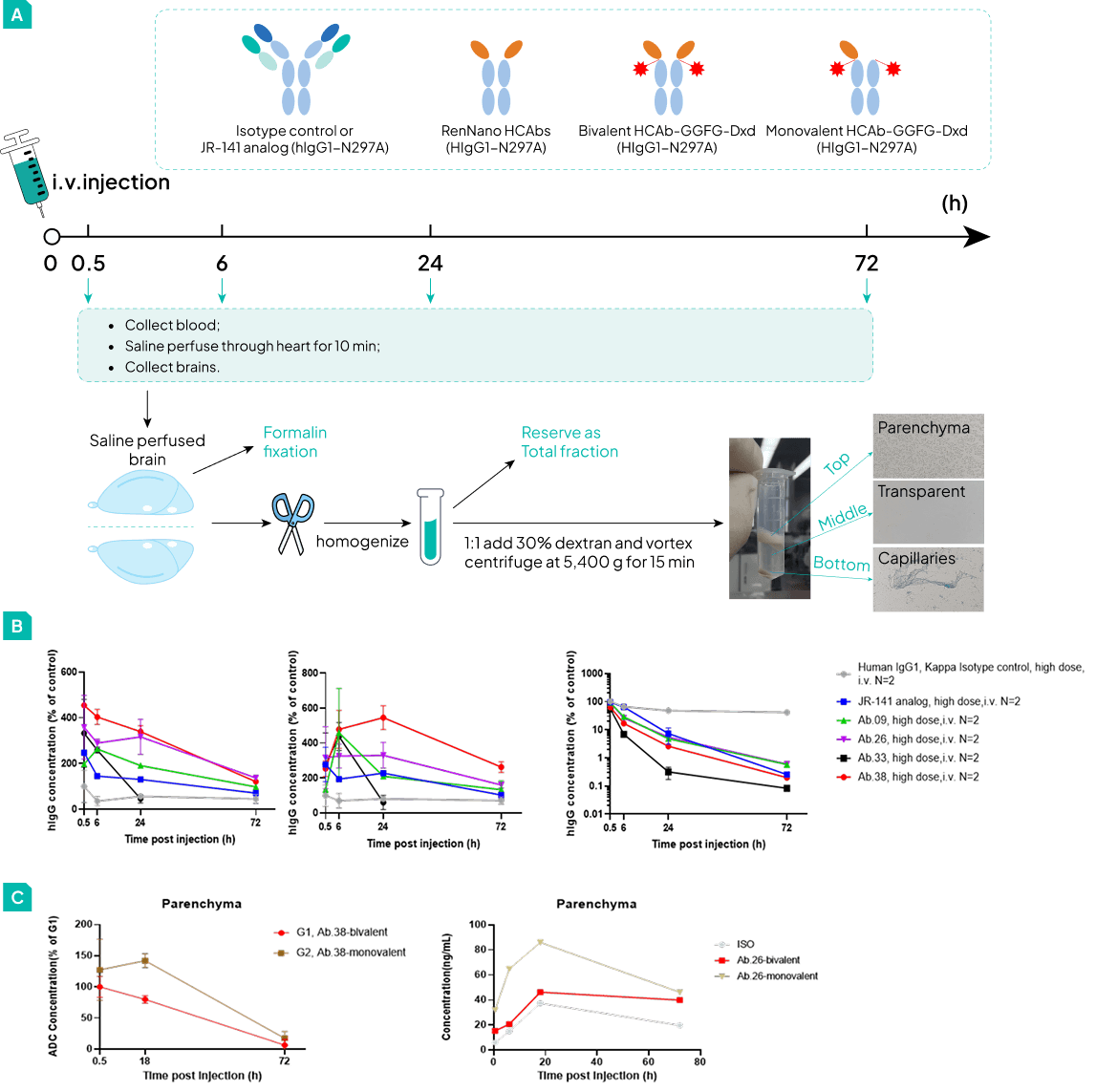
(A) Experimental scheme. (B) Human IgG (hIgG) concentrations in whole brain, brain parenchyma, and serum were measured by electrochemiluminescence assay (Meso Scale Discovery). Three of the four TfR1 HCAbs (Ab.38, Ab.26, and Ab.09) showed improved BBB penetration compared with the benchmark antibody JR-141 analog. (C) Ab.38 and Ab.26, conjugated with Dxd, demonstrated greater brain penetration in the monovalent HCAb format than in the bivalent format.
CD98 heavy chain (CD98hc; SLC3A2) is a transmembrane glycoprotein involved in amino acid transport. During receptor-mediated transcytosis, macromolecular payloads leveraging CD98 may better evade lysosomal degradation, making it a promising BBB shuttle for next-generation CNS drug delivery.
Fully Human mAbs
& HCabs
A diverse library including 46 monoclonal antibodies, 17 common light chain antibodies, and 4 HCAbs.
High Affinity &
Cross-Reactivity
Single-digit nM affinity with strong human/cyno cross-reactivity.
Superior In Vivo
Brain Exposure
Outperforms advanced industry benchmarks in vivo, with top clones achieving up to 2.73-fold increase in brain AUC.

Longer Brain PK vs.
TfR1
Extended half-life with brain AUC up to 208%, exceeding traditional TfR1 benchmarks (15%).

Strong
Developability
Robust BBB delivery across diverse formats (bivalent, monovalent, N-Fab, C-scFv) with strong stability and biophysical properties.
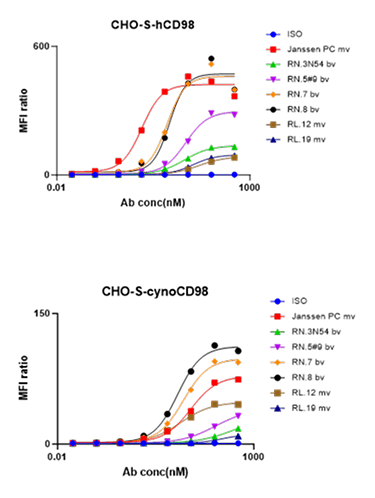
| Sample | hCD98 EC50(nM) | cynoCD98 EC50(nM) |
| ISO | - | - |
| Janssen PC mv | 2E+00 | 2E+01 |
| RN.3N54 bv | 2E+01 | 3E+02 |
| RN.5#9 bv | 2E+01 | 1E+02 |
| RN.7 bv | 7E+00 | 2E+01 |
| RN.8 bv | 8E+00 | 1E+01 |
| RL.12 mv | 5E+01 | 1E+01 |
| RL.19 mv | 3E+01 | 2E+01 |
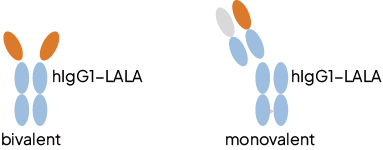
Abbreviations: Janssen PC mv: Janssen positive control in monovalent form. mv: monovalent. bv: bivalent. RN: RenNano® HCAbs. RL: RenLite® common light chain antibodies.
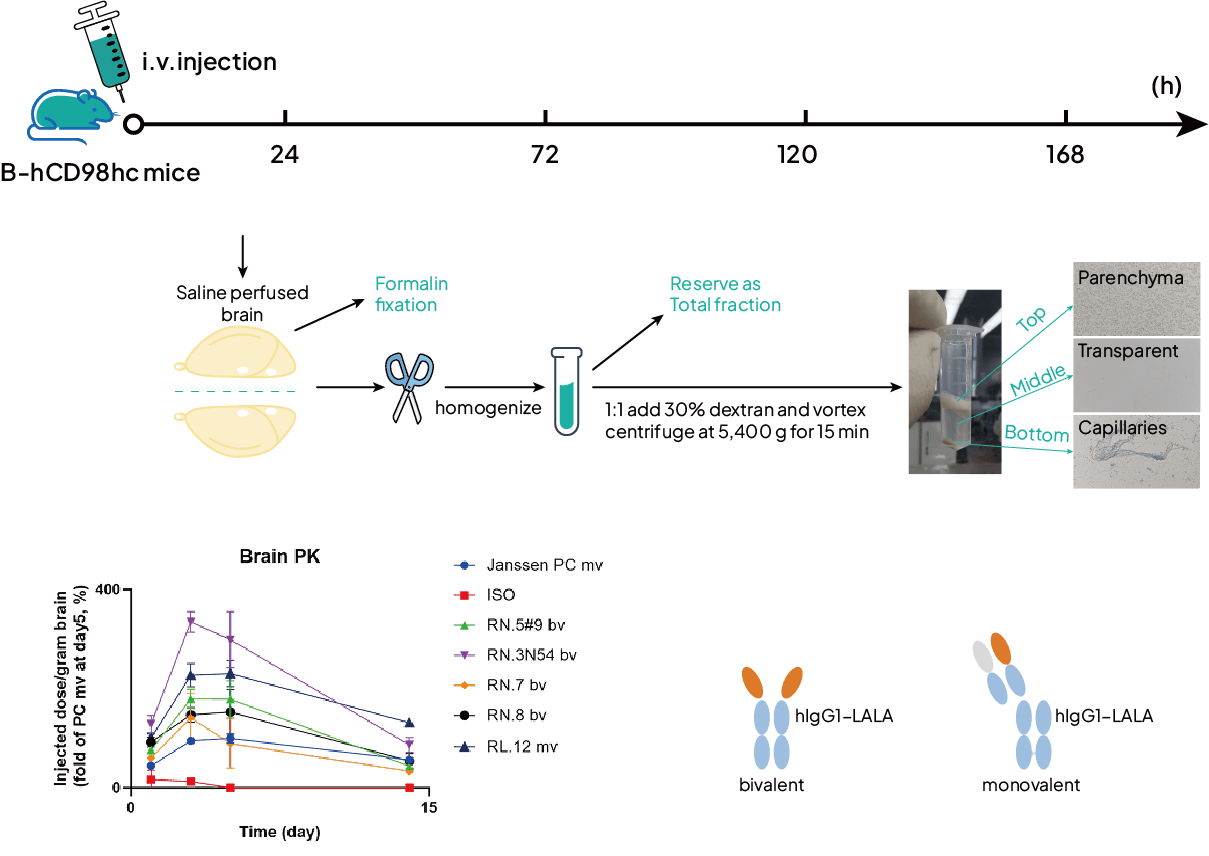
| Sample | PC mv | ISO | RN.5#9 bv | RN.3N54 bv | RN.7 bv | RN.8 bv | RL.12 mv |
| Brain PK AUC (fold vs. PC mv) | 100% | 4% | 155% | 273% | 95% | 142% | 232% |
(A) Experimental scheme. (B) Brain concentrations of CD98 antibodies were measured after dosing in B-hCD98hc humanized mice. RN.3N54 bv, RL.12 mv, RN.5#9 bv, and RN.8 bv showed increased brain exposure compared with the Janssen positive control (PC). ISO: nanobody negative control; mv: monovalent; bv: bivalent; RN: RenNano® HCAbs; RL: RenLite® common light chain antibodies.
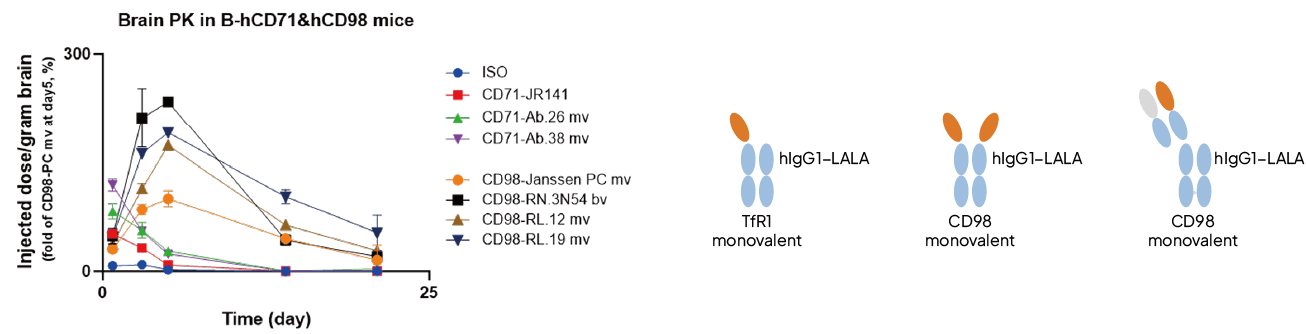
| Sample | ISO | CD71-JR141 | CD71-Ab.26 mv | CD71-Ab.38 mv | CD98-Janssen PC mv | CD98-RN.3N54 bv | CD98-RL.12 mv | CD98-RL.19 mv |
| Brain PK AUC (fold vs. CD98-PC) | 3% | 15% | 32% | 32% | 100% | 187% | 157% | 208% |
Brain concentrations of CD98 and TfR1 antibodies were measured after dosing in B-hTFR1/hCD98hc humanized mice. ISO: nanobody negative control; mv: monovalent; bv: bivalent; RN: RenNano® HCAbs; RL: RenLite® common light chain antibodies.
Connect with Biocytogen to explore our BBB shuttle antibody portfolio and partnership opportunities.
Request a Meeting