

CB17/lcr-PrkdcscidFcgr4tm2(FCGR3A)Bcgen/Bcgen • 113688
| Product name | B-hCD16A mice plus(CB-17 SCID) |
|---|---|
| Catalog number | 113688 |
| Strain name | CB17/lcr-PrkdcscidFcgr4tm2(FCGR3A)Bcgen/Bcgen |
| Strain background | CB-17 SCID |
| NCBI gene ID | (Human) |
| Aliases | Fcrl3; CD16-2; FcgRIV; Fcgr3a; FcgammaRIV; 4833442P21Rik |


Gene targeting strategy for B-hCD16A mice plus(CB-17 SCID).
The exons 1-5 of mouse Fcgr4 gene that encode extracellular domain are replaced by human counterparts in B-hCD16A mice plus(CB-17 SCID). The genomic region of mouse Fcgr4 gene that encodes transmembrane domain and cytoplasmic portion is retained. The promoter and 5’UTR region of the mouse gene are replaced by human counterparts. The chimeric CD16A expression is driven by endogenous human CD16A promoter, while mouse Fcgr4 gene transcription and translation will be disrupted.

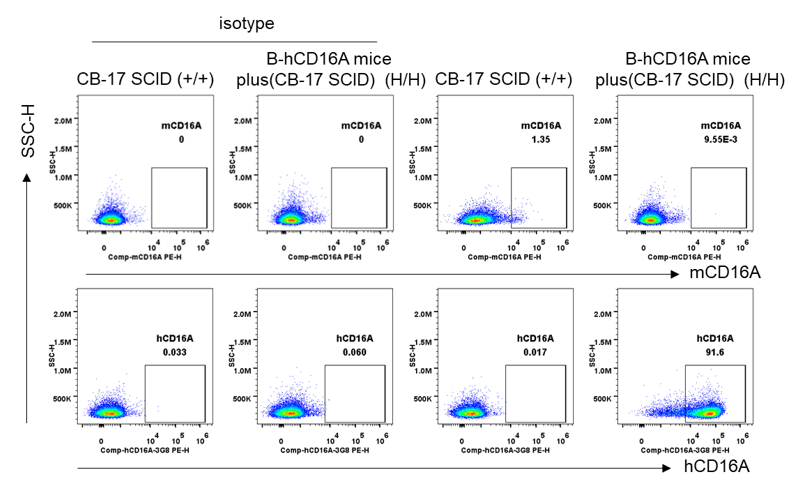
Strain specific CD16A expression analysis in wild-type CB-17 SCID mice and homozygous B-hCD16A mice plus(CB-17 SCID) by flow cytometry. Splenocytes were collected from wild-type CB-17 SCID mice (+/+) and homozygous B-hCD16A mice plus(CB-17 SCID) (H/H). Protein expression was analyzed with anti-mouse CD16.2 (FcγRIV) antibody (Biolegend, 149503) and anti-human CD16 antibody (Biolegend, 302008) by flow cytometry. Mouse CD16A was not detectable in NK cells of wild-type CB-17 SCID mice. Human CD16A was detectable in NK cells of homozygous B-hCD16A mice plus(CB-17 SCID), but not in wild-type CB-17 SCID mice.
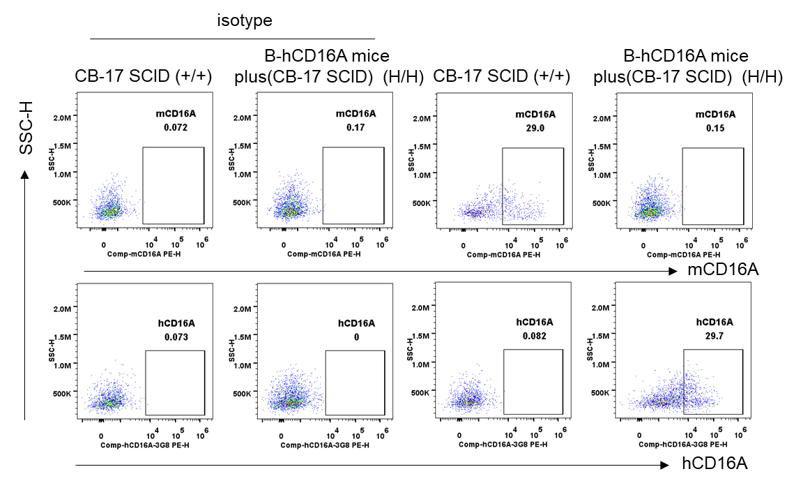
Strain specific CD16A expression analysis in wild-type CB-17 SCID mice and homozygous B-hCD16A mice plus(CB-17 SCID) by flow cytometry. Splenocytes were collected from wild-type CB-17 SCID mice (+/+) and homozygous B-hCD16A mice plus(CB-17 SCID) (H/H). Protein expression was analyzed with anti-mouse CD16.2 (FcγRIV) antibody (Biolegend, 149503) and anti-human CD16 antibody (Biolegend, 302008) by flow cytometry. Mouse CD16A was detectable in DCs of wild-type CB-17 SCID mice. Human CD16A was detectable in DCs of homozygous B-hCD16A mice plus(CB-17 SCID), but not in wild-type CB-17 SCID mice.
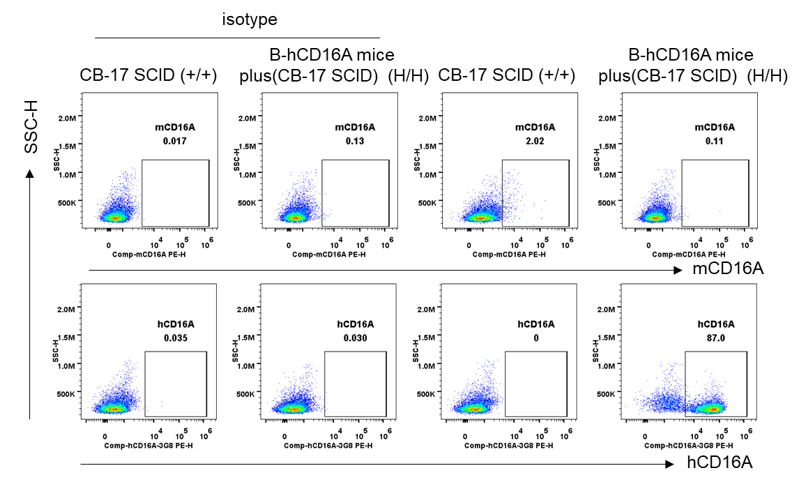
Strain specific CD16A expression analysis in wild-type CB-17 SCID mice and homozygous B-hCD16A mice plus(CB-17 SCID) by flow cytometry. Splenocytes were collected from wild-type CB-17 SCID mice (+/+) and homozygous B-hCD16A mice plus(CB-17 SCID) (H/H). Protein expression was analyzed with anti-mouse CD16.2 (FcγRIV) antibody (Biolegend, 149503) and anti-human CD16 antibody (Biolegend, 302008) by flow cytometry. Mouse CD16A was weakly detectable in monocytes of wild-type CB-17 SCID mice. Human CD16A was detectable in monocytes of homozygous B-hCD16A mice plus(CB-17 SCID), but not in wild-type CB-17 SCID mice.
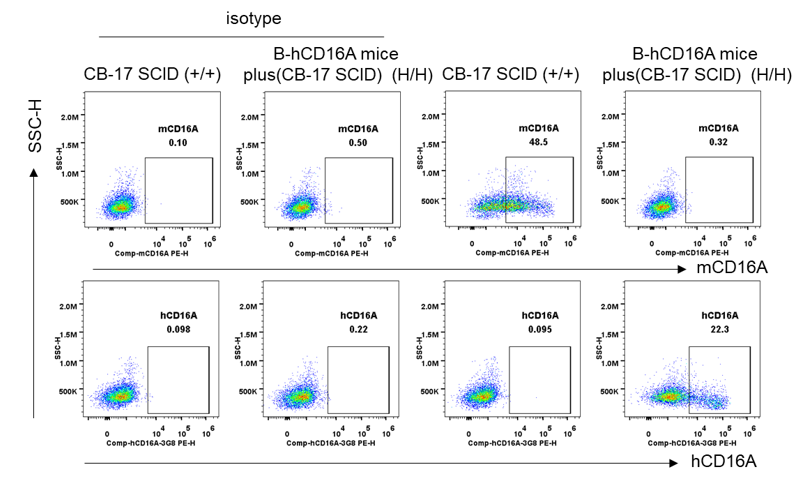
Strain specific CD16A expression analysis in wild-type CB-17 SCID mice and homozygous B-hCD16A mice plus(CB-17 SCID) by flow cytometry. Splenocytes were collected from wild-type CB-17 SCID mice (+/+) and homozygous B-hCD16A mice plus(CB-17 SCID) (H/H). Protein expression was analyzed with anti-mouse CD16.2 (FcγRIV) antibody (Biolegend, 149503) and anti-human CD16 antibody (Biolegend, 302008) by flow cytometry. Mouse CD16A was detectable in macrophages of wild-type CB-17 SCID mice. Human CD16A was detectable in macrophages of homozygous B-hCD16A mice plus(CB-17 SCID), but not in wild-type CB-17 SCID mice.
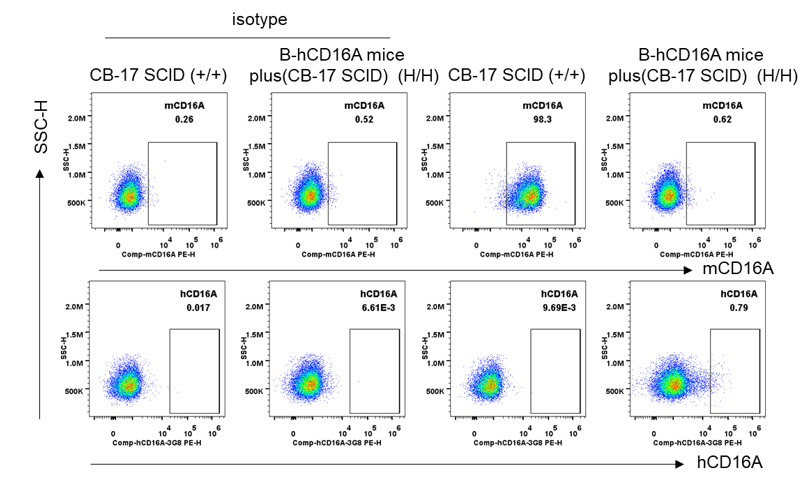
Strain specific CD16A expression analysis in wild-type CB-17 SCID mice and homozygous B-hCD16A mice plus(CB-17 SCID) by flow cytometry. Splenocytes were collected from wild-type CB-17 SCID mice (+/+) and homozygous B-hCD16A mice plus(CB-17 SCID) (H/H). Protein expression was analyzed with anti-mouse CD16.2 (FcγRIV) antibody (Biolegend, 149503) and anti-human CD16 antibody (Biolegend, 302008) by flow cytometry. Mouse CD16A was detectable in neutrophils of wild-type CB-17 SCID mice. Human CD16A was not detectable in neutrophils of homozygous B-hCD16A mice plus(CB-17 SCID).
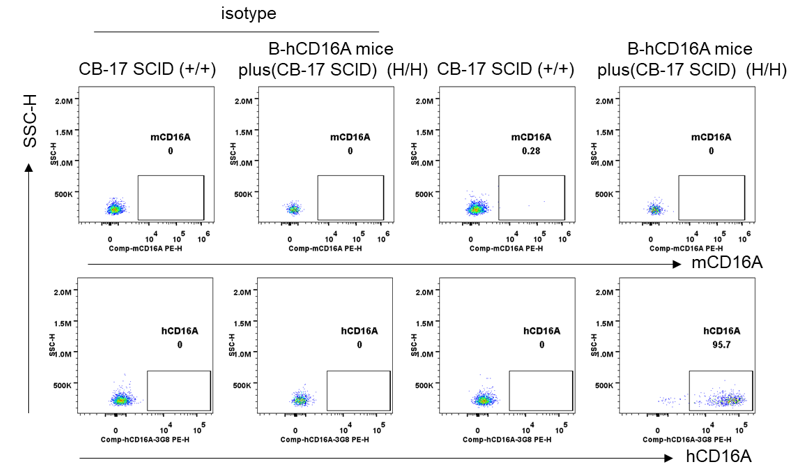
Strain specific CD16A expression analysis in wild-type CB-17 SCID mice and homozygous B-hCD16A mice plus(CB-17 SCID) by flow cytometry. Blood were collected from wild-type CB-17 SCID mice (+/+) and homozygous B-hCD16A mice plus(CB-17 SCID) (H/H). Protein expression was analyzed with anti-mouse CD16.2 (FcγRIV) antibody (Biolegend, 149503) and anti-human CD16 antibody (Biolegend, 302008) by flow cytometry. Mouse CD16A was not detectable in NK cells of wild-type CB-17 SCID mice. Human CD16A was detectable in NK cells of homozygous B-hCD16A mice plus(CB-17 SCID), but not in wild-type CB-17 SCID mice.
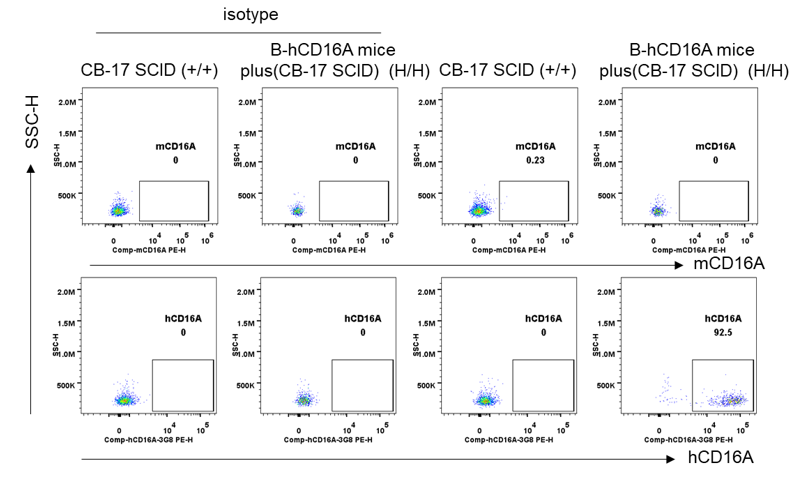
Strain specific CD16A expression analysis in wild-type CB-17 SCID mice and homozygous B-hCD16A mice plus(CB-17 SCID) by flow cytometry. Blood were collected from wild-type CB-17 SCID mice (+/+) and homozygous B-hCD16A mice plus(CB-17 SCID) (H/H). Protein expression was analyzed with anti-mouse CD16.2 (FcγRIV) antibody (Biolegend, 149503) and anti-human CD16 antibody (Biolegend, 302008) by flow cytometry. Mouse CD16A was not detectable in monocytes of wild-type CB-17 SCID mice. Human CD16A was detectable in monocytes of homozygous B-hCD16A mice plus(CB-17 SCID), but not in wild-type CB-17 SCID mice.
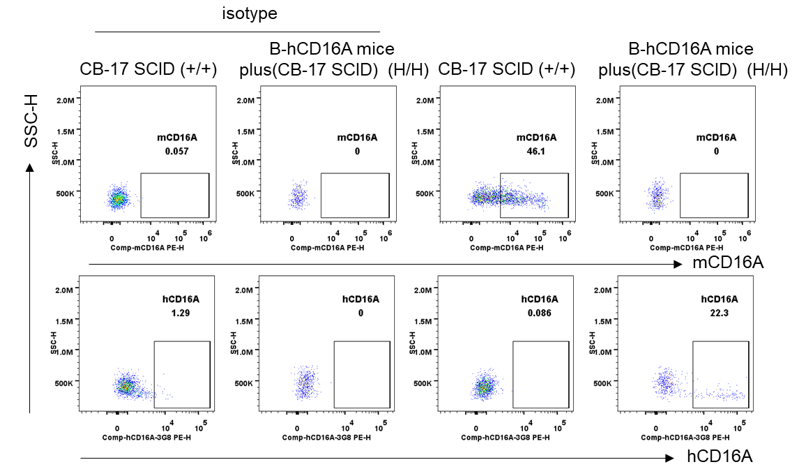
Strain specific CD16A expression analysis in wild-type CB-17 SCID mice and homozygous B-hCD16A mice plus(CB-17 SCID) by flow cytometry. Blood were collected from wild-type CB-17 SCID mice (+/+) and homozygous B-hCD16A mice plus(CB-17 SCID) (H/H). Protein expression was analyzed with anti-mouse CD16.2 (FcγRIV) antibody (Biolegend, 149503) and anti-human CD16 antibody (Biolegend, 302008) by flow cytometry. Mouse CD16A was detectable in macrophages of wild-type CB-17 SCID mice. Human CD16A was detectable in macrophages of homozygous B-hCD16A mice plus(CB-17 SCID), but not in wild-type CB-17 SCID mice.
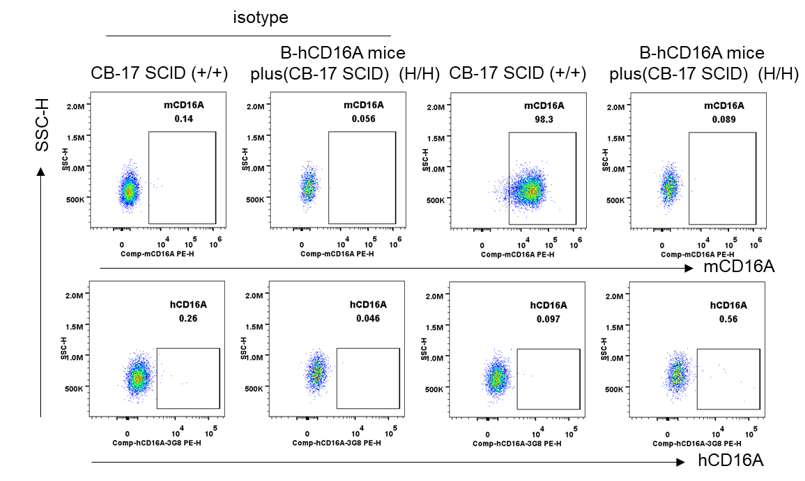
Strain specific CD16A expression analysis in wild-type CB-17 SCID mice and homozygous B-hCD16A mice plus(CB-17 SCID) by flow cytometry. Blood were collected from wild-type CB-17 SCID mice (+/+) and homozygous B-hCD16A mice plus(CB-17 SCID) (H/H). Protein expression was analyzed with anti-mouse CD16.2 (FcγRIV) antibody (Biolegend, 149503) and anti-human CD16 antibody (Biolegend, 302008) by flow cytometry. Mouse CD16A was detectable in neutrophils of wild-type CB-17 SCID mice. Human CD16A was not detectable in neutrophils of homozygous B-hCD16A mice plus(CB-17 SCID).
