

NOD.CB17-Prkdcscid Il2rgtm1Bcgen Epcamtm1(EPCAM)Bcgen/Bcgen • 112660
| Product name | B-NDG hEPCAM mice |
|---|---|
| Catalog number | 112660 |
| Strain name | NOD.CB17-Prkdcscid Il2rgtm1Bcgen Epcamtm1(EPCAM)Bcgen/Bcgen |
| Strain background | B-NDG |
| NCBI gene ID | (Human) |
| Aliases | EGP; Ly74; gp40; CD326; EGP-2; TROP1; Egp314; Ep-CAM; EpCAM1; Tacsd1; GA733-2; Tacstd1; gc; p64; [g]c; CD132; gamma(c); p460; scid; slip; DNAPK; DNPK1; HYRC1; XRCC7; dxnph; DOXNPH; DNAPDcs; DNA-PKcs |

Gene targeting strategy for B-NDG hEPCAM mice. The exons 3-8 of mouse Epcam genes that encode the extracellular domain and part of transmembrane domain are replaced by human EPCAM exons 2-7 in B-NDG hEPCAM mice. The genomic region of mouse Epcam gene that encodes signal peptide, part of e transmembrane domain, and cytoplasmic portion is retained. The promoter, 5’UTR, and 3’UTR region of the mouse gene are also retained. The chimeric EPCAM expression is driven by endogenous mouse Epcam promoter, while mouse Epcam gene transcription and translation will be disrupted.

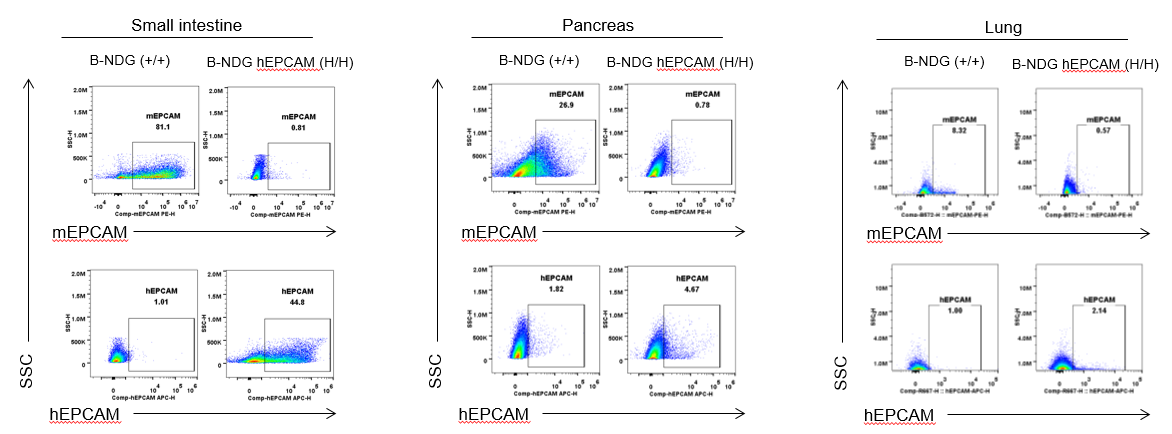
Strain specific EPCAM expression analysis in homozygous B-NDG hEPCAM mice by flow cytometry. Small intestine, pancreas and lung were collected from wild-type B-NDG mice (+/+) and homozygous B-NDG hEPCAM mice (H/H), and CD45 negative cells were analyzed by flow cytometry with species-specific anti-mouse EPCAM antibody (Biolegend, 118205) and anti-human EPCAM antibody (Biolegend, 369809/324208). Mouse EPCAM was detectable in wild-type B-NDG mice. Human EPCAM was exclusively detectable in homozygous B-NDG hEPCAM mice but not in wild-type mice.
